Yark
Yarks are Natura Oceans Finers that inhabit both seas and rivers across the world. They are among the most common aquatic predators, though this does not make them any less dangerous.
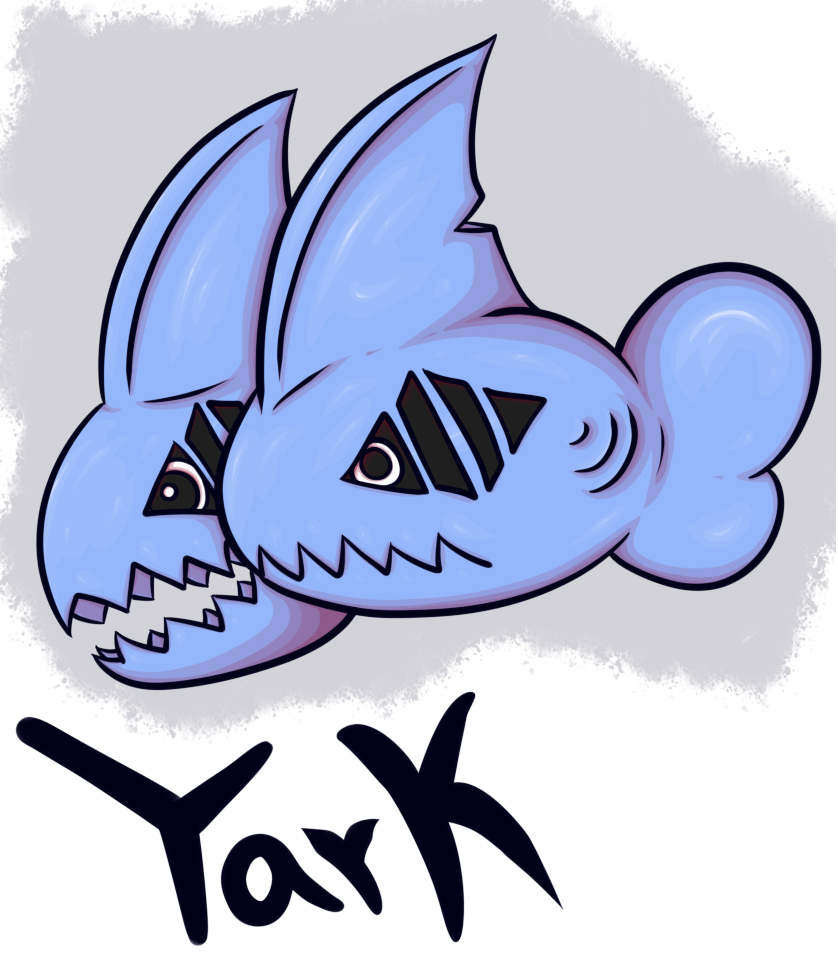
Yarks are medium-sized, round, blue creatures characterized by a large pointed dorsal fin and a broad, rounded tail. They possess a sharp mouth filled with pointed teeth, and black eyes with white pupils. Their eyes are partially shielded by protective strips of tissue resembling bars, with gills located nearby.
Yarks are some of the most widespread underwater predators in their ecosystems, inhabiting nearly every type of water mass around the world. They primarily prey on other Finers species—both smaller and larger than themselves—which often leads them into conflict.
Lacking side fins, Yarks are capable only of forward movement. They have specialized heavily in this trait, using rapid tail movements to propel themselves straight ahead at high speed. They attack prey by ramming forward and biting with their fangs, and rely on this same motion to swallow the meat that enters their mouths.
Their skin is thick and durable, providing protection for their otherwise fragile internal organs. This includes their eyes, which are guarded behind skin straps similar to jail bars. Only the skin surrounding the dorsal fin—and the fin itself—is less resistant than the rest of the body; it is common for Yarks to lose small pieces of this fin over time.
Yark pupils can change shape, forming additional rings or shifting entirely to different patterns. It is believed that each pupil configuration provides specific benefits, adapting to different types of prey or environmental conditions. Water clarity and other factors are also thought to influence these changes.
Yarks spend most of their time hunting, typically swimming close to the sea floor while searching for prey. Once they locate a target, they lunge forward to bite, either swallowing it whole or tearing off large chunks. They are also known to leap out of the water to attack surface-level prey. If they encounter something they cannot bite, they often flee rapidly.
Yarks have no natural limit to growth or age. A well-cared-for Yark can continue growing indefinitely, as their cells do not naturally degrade over time. This can result in extremely large individuals, though most do not survive long enough to reach notable sizes.
For sleep, Yarks seek out a large, open area to swim through before entering a kind of “auto mode,” where they continue moving forward slowly while resting one half of their brain at a time. They do not remain still while resting, and both halves of the brain only sleep simultaneously when the Yark is extremely tired or ill.
Yarks group themselves by size, typically traveling and hunting in similarly sized groups. When two groups of different sizes meet, they engage in brief territorial fights, attempting to bite one another’s skin. If the smaller group cannot injure the larger one, they must retreat and yield the territory; the opposite occurs if they can inflict damage.
Yark dorsal fin meat is used in various dishes along coastal regions, especially in Spain, Terraido, and Polsize. Because each fin yields only a small amount of meat, many Yarks must be hunted to obtain a full serving. Despite demand, Yarks cannot be bred in captivity.
Female Yarks lay unfertilized eggs randomly on the sea floor once they reach maturity, and then once every five months thereafter. Male Yarks locate these eggs during their travels and fertilize them if the area appears safe. The eggs eventually hatch into offspring that must survive independently, initially feeding on Bianton and carrion until they are large enough to hunt or join a group.
Yarks are regarded as dangerous, and areas where they reside are often evacuated to prevent attacks. However, while hazardous, they are not the most dangerous aquatic predators and rarely cause major incidents.
Branch: Natura
Category: Oceans
Subcategory: Finers
Etymology: "Yacht" + "Shark"
Sex Ratio: 50% Male/50% Female
Sapience: ---